Hail Diameter | Web Scraping Tool | ScrapeStorm
Abstract:Hail diameter is a core physical parameter for measuring hailstone size, typically recorded in millimeters (mm) or centimeters (cm). ScrapeStormFree Download
ScrapeStorm is a powerful, no-programming, easy-to-use artificial intelligence web scraping tool.
Introduction
Hail diameter is a core physical parameter for measuring hailstone size, typically recorded in millimeters (mm) or centimeters (cm). Hail is a form of solid precipitation, consisting of spherical or conical ice pellets with alternating transparent and opaque layers. The diameter range varies dramatically—common hailstones generally measure between 5 mm and 50 mm, but in extreme cases, the largest hailstones can exceed 10 cm (100 mm) in diameter. Hail diameter is a key indicator for assessing hail disaster intensity and destructive power; the larger the diameter, the greater the threat to crops, buildings, and human/animal safety. In meteorological observation, the maximum diameter of the largest hailstone should be measured during a hailstorm and recorded in millimeters. When the maximum diameter exceeds 10 mm, the maximum average weight of hailstones should also be measured and recorded in grams.
Applicable Scene
Hail diameter measurement and classification are widely applied across multiple fields. In meteorological monitoring and disaster warning, it serves as a core indicator for assessing hail intensity and issuing timely alerts. In agriculture, it helps evaluate crop damage and supports insurance claims for affected produce. In building design and engineering, historical hail diameter data guides the development of impact-resistant standards for roofs, glass facades, solar panels, and vehicles. In climate research, long-term diameter observations contribute to understanding hail formation mechanisms and improving numerical weather prediction models. In public safety and emergency management, diameter-based hazard levels inform evacuation plans and resource allocation. The insurance and reinsurance industry relies on hail diameter statistics for risk assessment and premium pricing. Finally, in education and public outreach, hail diameter concepts help raise public awareness and promote self-protection during hailstorms.
Pros: Hail diameter is an intuitive core indicator of hail disaster intensity. Measurement methods are diverse, ranging from manual direct measurement to automated sensors and image recognition technologies. Classification standards are clear, facilitating rapid disaster assessment and emergency response planning. Additionally, diameter data is valuable for improving weather forecasting models and validating numerical simulations.
Cons: Hail diameter measurement is limited by observation range and means—traditional ground-based equipment has limited coverage and struggles to capture the complete spatial distribution of hailstorms. Automated measurements (such as image recognition) require high image quality and algorithmic precision, with inherent margins of error. Furthermore, hailstones often have irregular shapes (spherical, conical, or irregular), so the definition and operational standards for “maximum diameter” require careful judgment by observers; otherwise, data consistency may be compromised.
Legend
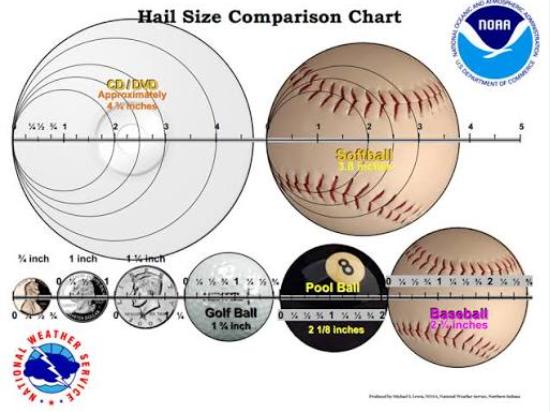
1. Hail size.
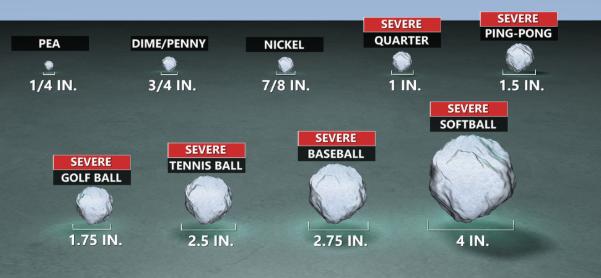
2. Hail size.