
Thunderstorm Frequency (times/hour) | Web Scraping Tool | ScrapeStorm
Abstract:Thunderstorm Frequency (times/hour) refers to the number of thunderstorm occurrences observed in a given area within a unit of time, usually per hour. It is used to describe the activity level and temporal-spatial distribution of thunderstorms. This metric is commonly applied in meteorological monitoring, hazard warning, power system protection, and aviation safety assessment, and serves as an important reference for evaluating convective weather activity. ScrapeStormFree Download
ScrapeStorm is a powerful, no-programming, easy-to-use artificial intelligence web scraping tool.
Introduction
Thunderstorm Frequency (times/hour) refers to the number of thunderstorm occurrences observed in a given area within a unit of time, usually per hour. It is used to describe the activity level and temporal-spatial distribution of thunderstorms. This metric is commonly applied in meteorological monitoring, hazard warning, power system protection, and aviation safety assessment, and serves as an important reference for evaluating convective weather activity.
Applicable Scene
It is suitable for weather station monitoring, nowcasting, lightning protection design for transmission lines, airport operation support, outdoor construction safety management, and regional disaster risk assessment. For example, by analyzing thunderstorm frequency during the convective season in a certain area, meteorologists and operators can identify peak thunderstorm periods and support work suspension alerts, flight scheduling, and equipment protection.
Pros: Thunderstorm frequency is intuitive and easy to calculate, making it useful for reflecting changes in thunderstorm activity over time. When combined with lightning detection, precipitation radar, wind fields, and satellite cloud imagery, it can help identify active severe convection zones and high-risk periods.
Cons: This metric only reflects the number of thunderstorm occurrences and may not fully capture storm intensity, duration, affected area, or damage level. Differences in observation methods, identification criteria, and statistical standards across regions may also reduce data comparability. In addition, localized severe convection can develop suddenly, so relying solely on frequency may be insufficient.
Legend
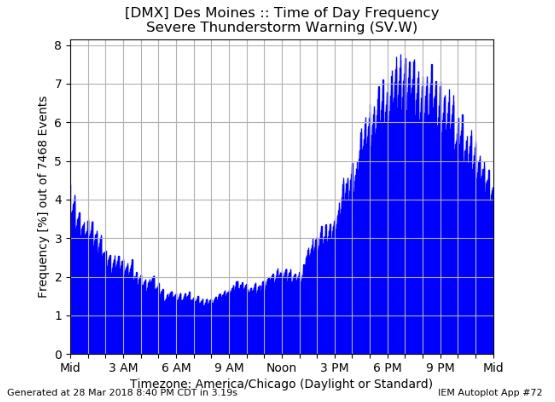
1. Severe TStorm Warnings by Time of Day.
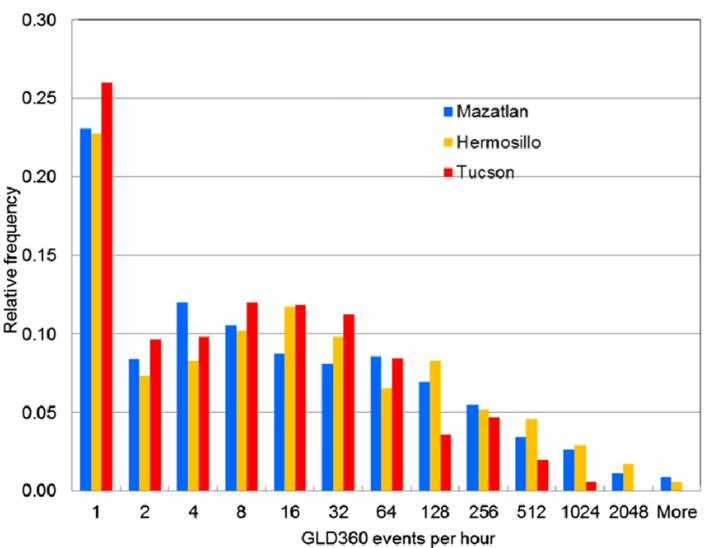
2. The distribution of the number of strokes per thunderstorm hour on a base-2 logarithmic scale in three cities whose locations are identified in Fig. 2.
Related Article
Reference Link
http://thunderhours.earthnetworks.com/