Jekyll | Web Scraping Tool | ScrapeStorm
Abstract:Jekyll is an open-source static site generator developed in Ruby. It generates pre-built static web pages from files such as Markdown, HTML, Liquid templates, and CSS. It requires no database or server-side application processing, and the generated HTML files can be served from a web server or CDN, enabling the construction of fast and stable websites. It is suitable for producing blogs, documentation sites, portfolios, corporate sites, and more, and it supports version control combined with Git as well as free hosting using GitHub Pages. It also provides features such as layouts, includes, collections, tags, and categories, allowing flexible handling from simple static sites to content sites of a certain scale. ScrapeStormFree Download
ScrapeStorm is a powerful, no-programming, easy-to-use artificial intelligence web scraping tool.
Introduction
Jekyll is an open-source static site generator developed in Ruby. It generates pre-built static web pages from files such as Markdown, HTML, Liquid templates, and CSS. It requires no database or server-side application processing, and the generated HTML files can be served from a web server or CDN, enabling the construction of fast and stable websites. It is suitable for producing blogs, documentation sites, portfolios, corporate sites, and more, and it supports version control combined with Git as well as free hosting using GitHub Pages. It also provides features such as layouts, includes, collections, tags, and categories, allowing flexible handling from simple static sites to content sites of a certain scale.

Applicable Scene
Jekyll is widely used for websites that do not require frequent real-time updates or complex data processing. It is particularly suitable when content is to be managed on a file basis, such as corporate sites, technical documentation, product manuals, personal blogs, portfolios, and official project sites. Through integration with GitHub Pages, a site can be published automatically simply by registering content in a repository, making it suitable for open-source projects and developer-oriented sites. In addition, by combining it with CI/CD tools such as GitHub Actions, the flow from content updates to building and publishing can be automated. Furthermore, because static files can be delivered from a CDN, it is also used for high-traffic campaign sites and information disclosure sites with high security requirements.
Pros: Jekyll’s greatest advantage is that it requires no database or server-side runtime environment and can serve pre-generated static files. This makes page display fast, less susceptible to server or database failures, and reduces operational costs and security risks. Because content can be created using Markdown, it is easier to manage than writing HTML directly, and change history management via Git and collaborative editing by multiple people are also easy. By using Liquid templates, layouts, and includes, common headers, footers, navigation, and other elements can be reused, maintaining consistency across the entire site. Another major advantage is that integration with GitHub Pages is easy, allowing a site to be published with relatively little configuration. Since output is static HTML, it is also easy to design appropriate HTML structures and metadata for SEO and accessibility.
Cons: Because Jekyll is a mechanism for generating static sites, it does not provide standard dynamic features such as editing from an administrative interface, user registration, comments, inventory management, search, or member-only content. If these features are needed, it is necessary to combine external services, JavaScript, or a separate backend API. Additionally, updating content basically requires file editing and rebuilding the site, so for sites that non-technical users update frequently, the operational difficulty may be higher compared to a dedicated CMS. Knowledge of Ruby, Liquid, Git, and build environments is also required, and when using plugins or themes, dependency and compatibility management is necessary. Furthermore, for sites with very large content volumes, build times may become long, making it unsuitable when information needs to be reflected in real time. Therefore, when adopting Jekyll, it is important to consider in advance the update frequency, required dynamic features, the technical skills of the operators, and methods of integration with external services.
Legend
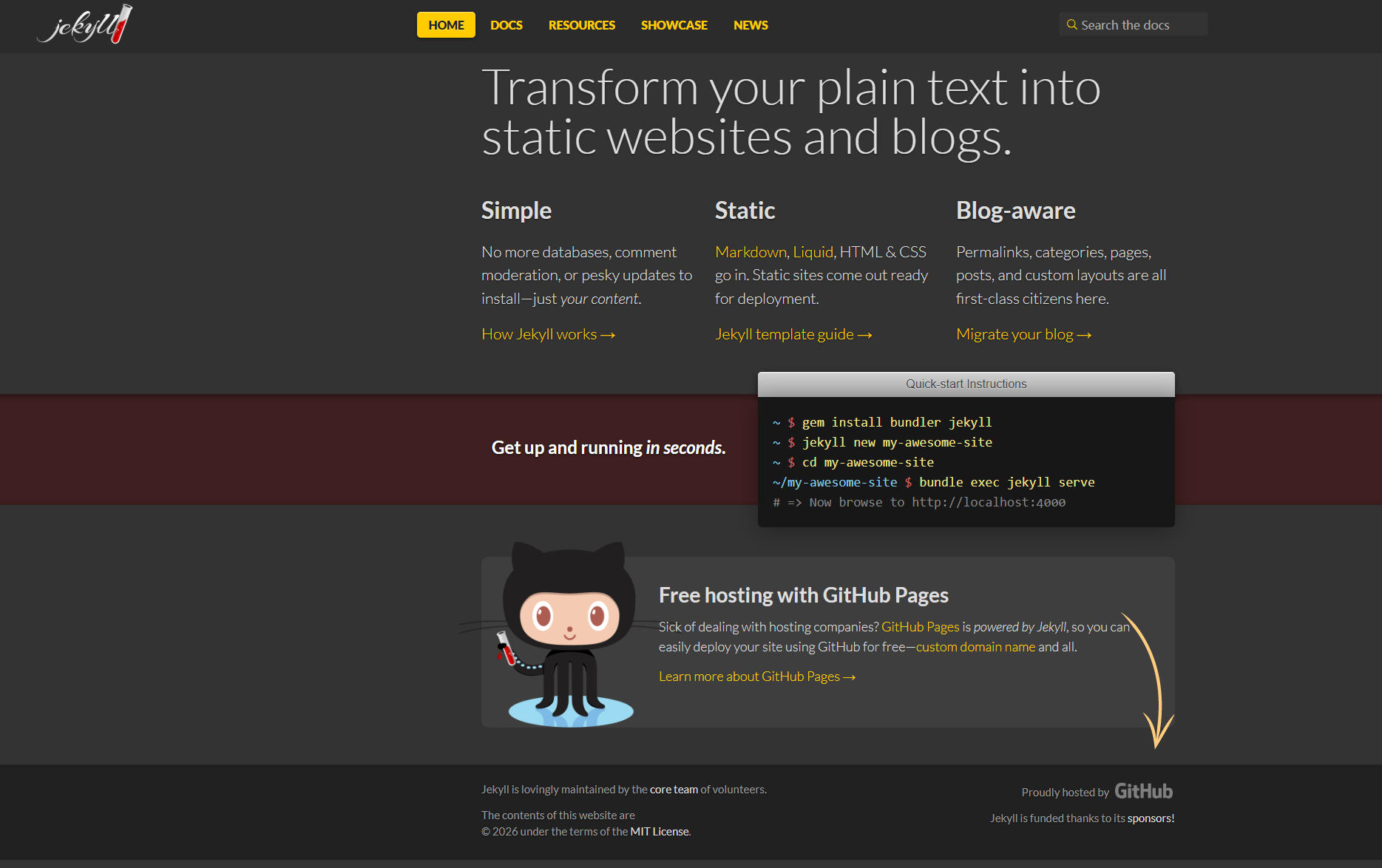
1. Jekyll homepage.
2. Jekyll news page.