
Soil Heat Flux | Web Scraping Tool | ScrapeStorm
Abstract:Soil Heat Flux refers to the amount of heat exchanged per unit time through a unit area of the soil interface, typically expressed in watts per square meter (W/m²). ScrapeStormFree Download
ScrapeStorm is a powerful, no-programming, easy-to-use artificial intelligence web scraping tool.
Introduction
Soil Heat Flux refers to the amount of heat exchanged per unit time through a unit area of the soil interface, typically expressed in watts per square meter (W/m²). It is a key component of the surface energy balance equation, reflecting the heat transfer process between the soil and the atmosphere, as well as between different layers within the soil. When soil heat flux is positive, it indicates heat transfer into deeper soil layers; when negative, it indicates heat release from deeper layers to the surface. Soil heat flux is influenced by various factors including soil temperature gradient, soil thermal conductivity, soil moisture content, soil texture, and surface cover conditions. It is an important physical parameter for understanding surface energy distribution, soil thermal regimes, and land surface processes.
Applicable Scene
Soil heat flux is widely used in agricultural meteorology, climate modeling, ecology, hydrology, and engineering geology. In agriculture, it helps analyze soil thermal effects on crop growth and provides guidance for farmland water and heat management. In climate and land surface modeling, it is critical for energy balance closure and affects model accuracy for surface temperature and evapotranspiration. In permafrost regions, it aids in studying freeze-thaw impacts on infrastructure. In ecology, it helps understand energy distribution across different ecosystems.
Pros: Soil heat flux measurements provide quantitative insight into surface energy distribution. Direct measurements using heat flux plates offer high-temporal-resolution data for land surface research. Accurate flux modeling improves surface energy balance closure and enhances predictions of surface temperature and evapotranspiration. Long-term observations also support studies on soil thermal regime evolution under climate change, benefiting agricultural disaster prevention and water resource management.
Cons: Accurate measurement faces several challenges. Installing flux plates disturbs soil structure, causing measurement deviations. Soil thermal conductivity varies significantly with moisture, texture, and organic matter content, making single-point observations unrepresentative of larger areas. In permafrost regions, ice-water phase transitions release latent heat, complicating estimates. Additionally, surface energy balance closure issues persist in land surface research, with soil heat flux uncertainty being a major contributing factor.
Legend
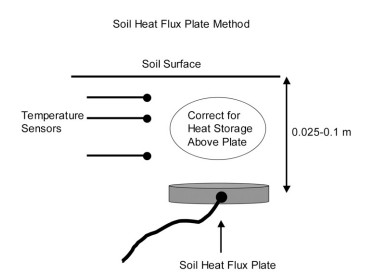
1. Soil Heat Flux Plate Method.
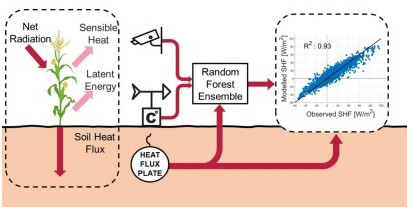
2. Soil heat flux.
Related Article
Reference Link
https://www.ars.usda.gov/research/publications/publication/?seqNo115=124485
https://link.springer.com/chapter/10.1007/978-1-4612-6205-3_4