
Data Provenance | Web Scraping Tool | ScrapeStorm
Abstract:Data Provenance refers to the practice of recording the full lifecycle history of data—from creation, flow, processing, to final usage—capturing all transformations and operations to ensure traceability and trustworthiness. It encompasses data sources, collection methods, transformation rules, storage locations, and every modification or transmission event, serving as a critical foundation for data quality management and audit compliance. Implementation approaches include metadata management, data lineage analysis, blockchain-based notarization, log tracking, and version control. ScrapeStormFree Download
ScrapeStorm is a powerful, no-programming, easy-to-use artificial intelligence web scraping tool.
Introduction
Data Provenance refers to the practice of recording the full lifecycle history of data—from creation, flow, processing, to final usage—capturing all transformations and operations to ensure traceability and trustworthiness. It encompasses data sources, collection methods, transformation rules, storage locations, and every modification or transmission event, serving as a critical foundation for data quality management and audit compliance. Implementation approaches include metadata management, data lineage analysis, blockchain-based notarization, log tracking, and version control.
Applicable Scene
Data provenance is widely applied in domains requiring high trust and strict regulatory oversight, such as transaction tracking and anti-fraud analysis in finance, patient data management and clinical trial auditing in healthcare, R&D data compliance in pharmaceuticals, open data source disclosure in government public data platforms, dataset version management and reproducibility assurance in scientific computing and AI model training, as well as root cause analysis and impact assessment for data quality issues in enterprise data governance.
Pros: Data provenance significantly enhances data transparency and trustworthiness, providing clear visibility into the data lifecycle and facilitating issue localization and accountability. When data anomalies or compliance risks arise, the provenance chain enables rapid tracing to the root cause with impact assessment, greatly reducing troubleshooting time. Comprehensive provenance records effectively support internal audits and external regulatory inspections, lowering compliance risks. In AI and big data scenarios, provenance ensures the reproducibility of model training datasets, reinforcing result credibility. When combined with technologies like blockchain, it can also provide tamper-proof trusted notarization, further strengthening data credibility.
Cons: Data provenance imposes significant system overhead, as recording every data change requires additional storage and computing resources, potentially impacting performance in high-volume, high-frequency data scenarios. Provenance information suffers from insufficient standardization, making it difficult to interoperate lineage and metadata formats across different systems, with high integration costs for cross-system tracing. The completeness and accuracy of provenance records depend on the cooperation of all nodes along the entire chain—any missing record at any point breaks the lineage trail. Additionally, provenance itself raises data security and privacy concerns, as detailed operational logs may expose sensitive business logic or personal information, requiring additional access control and data masking mechanisms.
Legend
1. Data provenance.
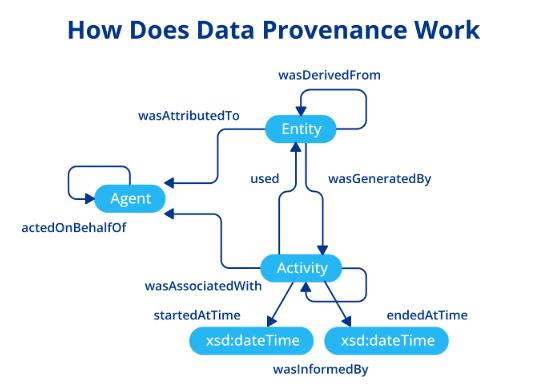
2. Data provenance.
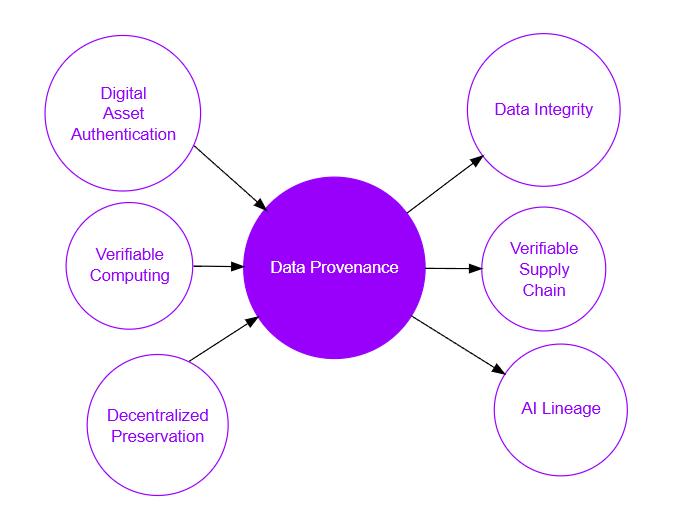
Related Article
Reference Link
https://www.ibm.com/think/topics/data-provenance