Hugo | Web Scraping Tool | ScrapeStorm
Abstract:Hugo is an open-source static site generator developed in the Go programming language. It combines content written in text formats such as Markdown with themes and templates to generate HTML files. It requires no database or server-side processing, and the generated static files can be served from a web server or CDN, enabling the construction of fast and stable websites. Hugo's standout feature is its extremely fast build speed—even sites with large numbers of pages can have their production files generated in a short time. It also provides features such as templating, content management, taxonomies, multilingual support, and image processing, and is used for a wide range of purposes including corporate sites, blogs, documentation sites, and portfolios. ScrapeStormFree Download
ScrapeStorm is a powerful, no-programming, easy-to-use artificial intelligence web scraping tool.
Introduction
Hugo is an open-source static site generator developed in the Go programming language. It combines content written in text formats such as Markdown with themes and templates to generate HTML files. It requires no database or server-side processing, and the generated static files can be served from a web server or CDN, enabling the construction of fast and stable websites. Hugo’s standout feature is its extremely fast build speed—even sites with large numbers of pages can have their production files generated in a short time. It also provides features such as templating, content management, taxonomies, multilingual support, and image processing, and is used for a wide range of purposes including corporate sites, blogs, documentation sites, and portfolios.

Applicable Scene
Hugo is well-suited for websites that require high-speed rendering performance and a simple operating environment. For example, it is highly effective for corporate sites, product introduction sites, technical documentation, news sites, blogs, and event sites—websites whose content can be pre-generated and then served. Because it can be published as static files, it pairs well with hosting services such as GitHub Pages, Netlify, Vercel, and Amazon S3, enabling low-cost and secure site operation. It also works easily with Git-based version control and CI/CD-driven automated builds and deployments, making it suitable for environments where developers and production teams manage content through a codebase. Furthermore, because it does not require a server-side database, it is also used for campaign sites that experience traffic spikes and for large-scale information distribution sites.
Pros: Hugo’s greatest advantage is the high-speed rendering performance and high stability achieved by generating static HTML. Since database queries and server-side processing are essentially unnecessary, pages load quickly and server load is kept low. Additionally, because the architecture serves generated files, the attack surface is smaller compared to dynamic CMSs, simplifying security measures and operational management. Build speed is also extremely fast, allowing efficient updates even for large-scale content sites. It enables flexible content management using Markdown, Go templates, shortcodes, and more, and themes and templates can be customized to implement original designs and functionality. It also provides features such as multilingual support, SEO-oriented metadata configuration, sitemap generation, RSS feeds, and image resizing and optimization, offering a broad range of capabilities needed to build modern websites.
Cons: Because Hugo is premised on static site generation, it does not provide, by default, a mechanism for non-technical users to edit content through an administrative interface, unlike dynamic CMSs such as WordPress. Therefore, content updates may require knowledge of Markdown, Git, the command line, and deployment environments. It is also difficult to implement server-side, real-time features such as membership registration, comments, search, reservations, and payments on its own, requiring integration with external services or additional backend systems. Customizing templates and themes requires understanding HTML, CSS, and JavaScript as well as Hugo’s own template syntax. Furthermore, as content volume and site structure grow more complex, build configuration, data management, and preview environment design become increasingly important. Consequently, when operations are centered on non-technical users or advanced dynamic functionality is a priority, it is worth considering combining Hugo with a headless CMS or a traditional CMS.
Legend
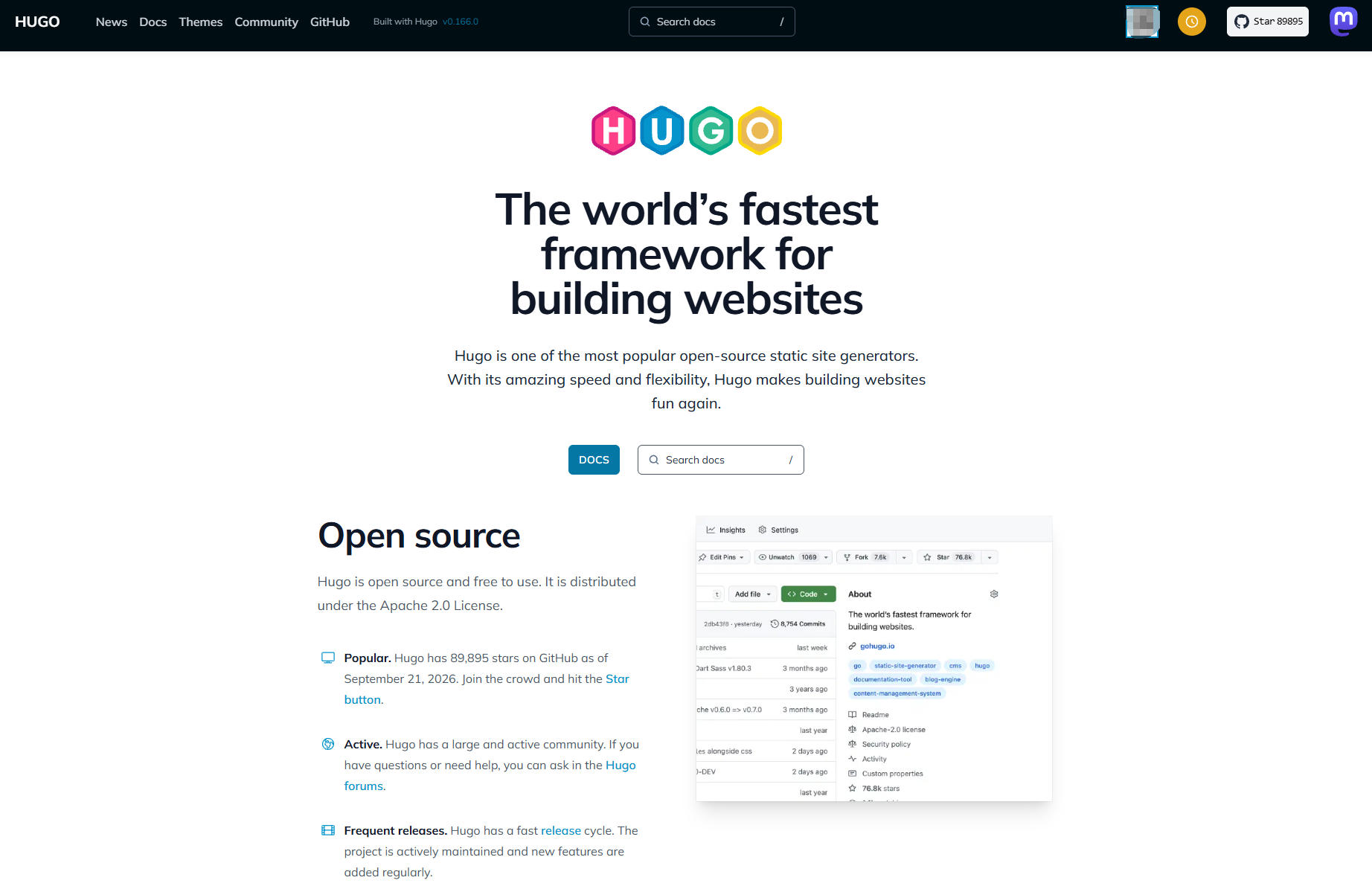
1. Hugo homepage.
2. Hugo article page.