Nuxt Content | Web Scraping Tool | ScrapeStorm
Abstract:Nuxt Content is a module for adding content management capabilities to Nuxt applications. ScrapeStormFree Download
ScrapeStorm is a powerful, no-programming, easy-to-use artificial intelligence web scraping tool.
Introduction
Nuxt Content is a module for adding content management capabilities to Nuxt applications. It treats files such as Markdown, JSON, and YAML as content, which can be easily read and displayed from Nuxt pages and components. Unlike traditional CMSs that register content in a database, it manages content primarily as files within the project, making it highly compatible with Git-based version control and review workflows. It also provides its own query functionality for searching and filtering content, and allows Vue components to be embedded within Markdown. It is used as a mechanism for efficiently building content-centric websites such as blogs and documentation sites on Nuxt.

Applicable Scene
Nuxt Content is widely used in websites that want to manage content on a file basis and in development projects using Nuxt. It is particularly suitable for text- and image-centric sites such as blogs, product documentation, knowledge bases, and corporate sites. For example, by managing articles in a Git repository, content can be published while reviewing change histories and conducting team reviews. Additionally, by combining it with Nuxt’s features, you can build pages that support static site generation and server-side rendering. Because content can be held in formats such as Markdown, it is also effective when developers want flexible control over site structure and presentation. On the other hand, for sites where multiple editors frequently update content from an administrative interface, integration with a separate CMS or editing tool may be necessary.
Pros: A major advantage of Nuxt Content is that content can be managed as files within the project, making it easy to incorporate into Git version control and development workflows. Because articles can be created primarily in Markdown, the content structure is easy to understand, making it a system that is easy to handle for developers and technically savvy editors. It also integrates naturally with Nuxt’s routing and rendering features, allowing flexible implementation of content search, categorization, and display. Since Vue components can be used within Markdown, it is also possible to create pages that combine text with interactive UI. In configurations without a dedicated administrative interface, it is possible to reduce the operational burden of CMS servers while achieving high-speed content delivery leveraging static site generation and similar approaches.
Cons: Because Nuxt Content manages content primarily as files, it may be difficult for non-technical users who want to edit articles through an administrative interface to use with the standard mechanism alone. If approval workflows involving multiple editors or fine-grained permission management are required, it is necessary to consider integration with another CMS or editing tool. Additionally, reflecting content additions or changes on the published site generally requires establishing mechanisms for committing to Git and for building and deploying. As site scale and search requirements grow, consideration must also be given to content design, query optimization, and build time management. Development and maintenance in accordance with Nuxt versions and module specifications are also required, so it is important to confirm the operational structure and how editors will use the system before adoption.
Legend
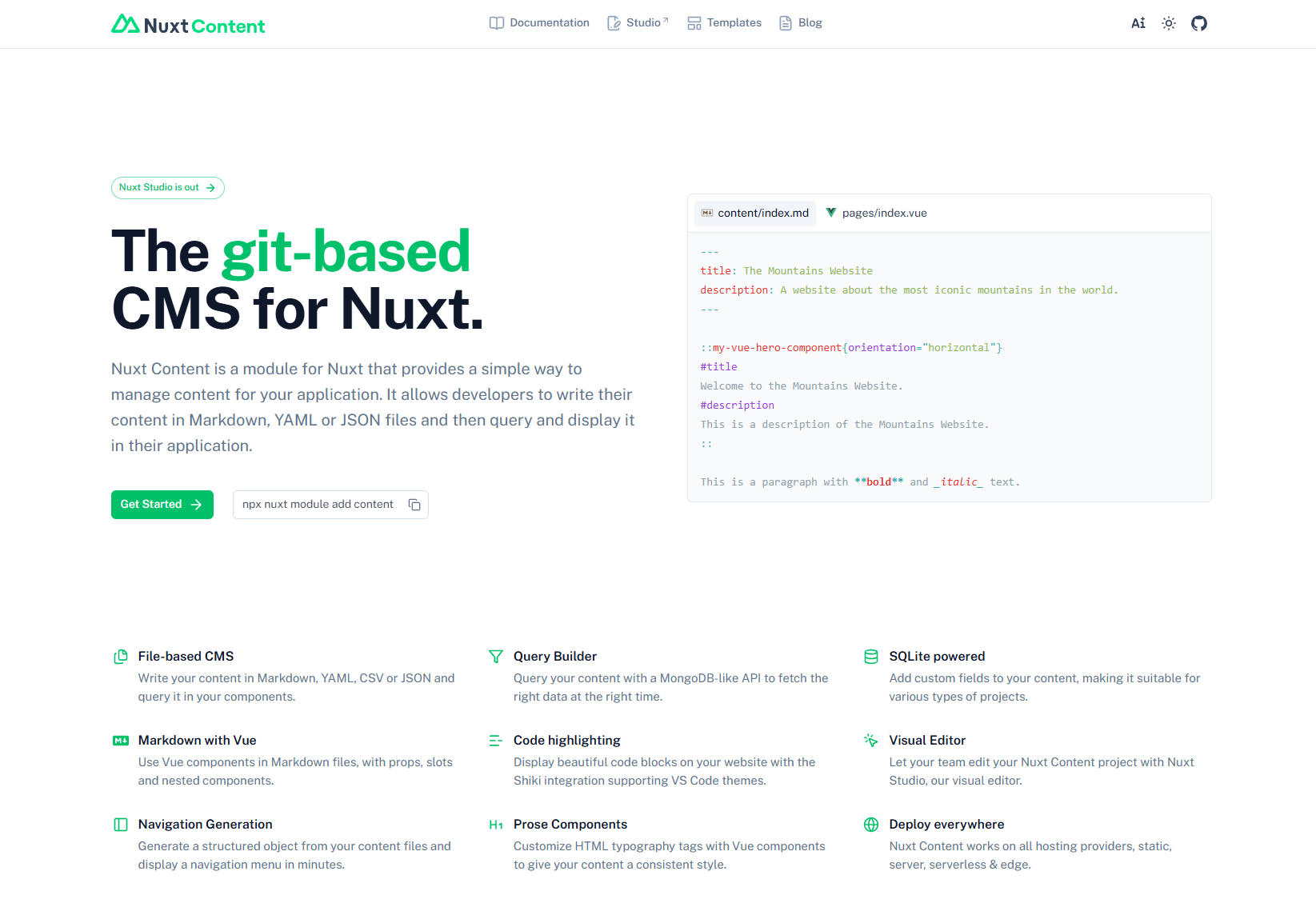
1. Nuxt Content homepage.
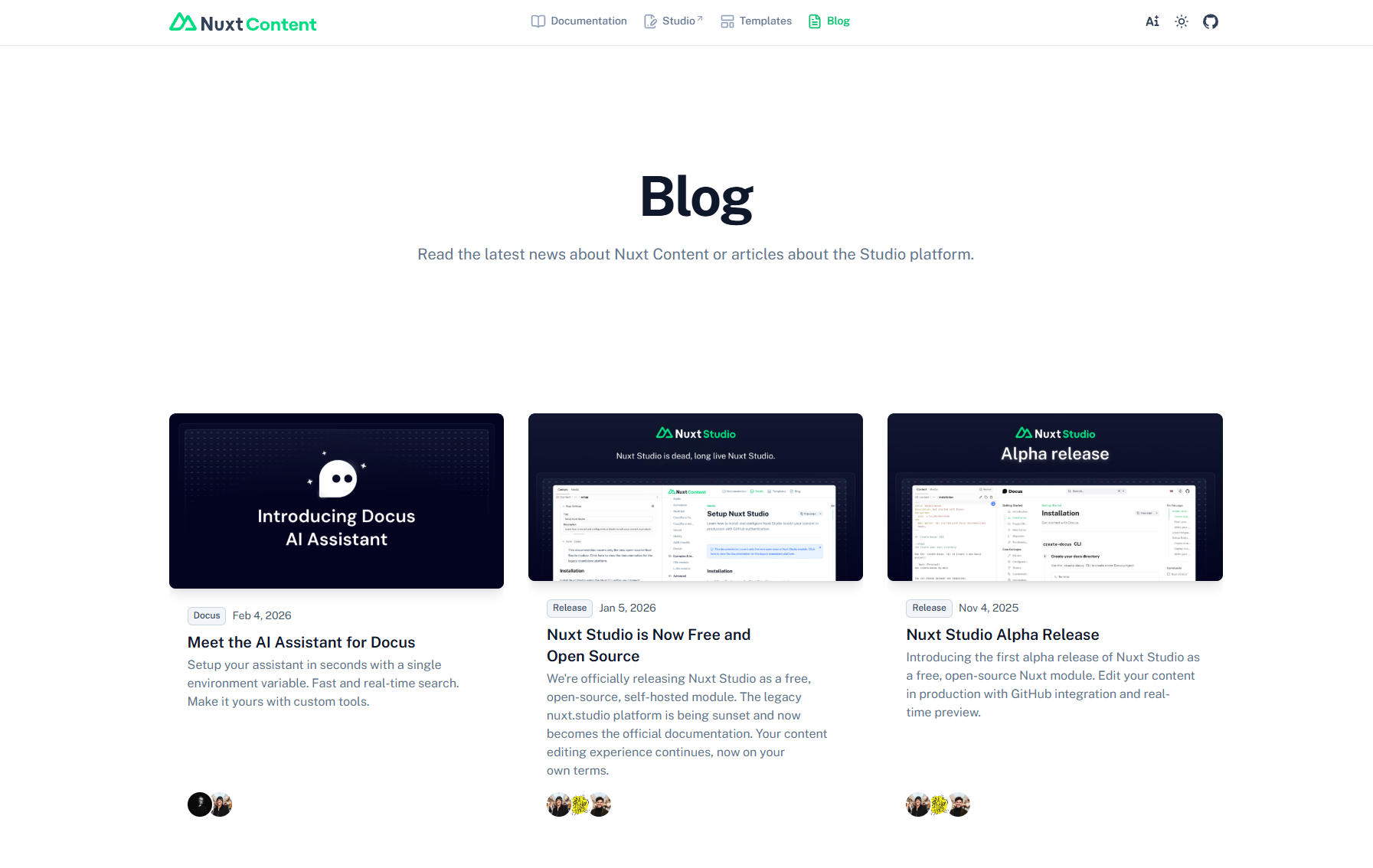
2. Nuxt Content blog page.