
Reflected Radiation | Web Scraping Tool | ScrapeStorm
Abstract:Reflected radiation refers to the electromagnetic energy emitted from sources such as the sun or artificial lighting that, after reaching the surface of the ground or an object, is not absorbed but is instead reflected back outward. ScrapeStormFree Download
ScrapeStorm is a powerful, no-programming, easy-to-use artificial intelligence web scraping tool.
Introduction
Reflected radiation refers to the electromagnetic energy emitted from sources such as the sun or artificial lighting that, after reaching the surface of the ground or an object, is not absorbed but is instead reflected back outward. It is primarily observed within the visible to near-infrared spectral range, and its reflection characteristics vary significantly depending on factors such as the material, surface condition, moisture content, roughness, and angle of incidence of the object. In the fields of Earth observation and remote sensing, reflected radiation is one of the most fundamental and important observational targets for acquiring surface information, serving as the basis for land cover classification and environmental analysis.
Applicable Scene
Reflected radiation is widely used in fields centered on remote sensing and optical observation. Through the analysis of reflected radiation from the surface in satellite imagery and aerial photographs, information such as vegetation distribution, crop growth status, forest health, and land use in urban areas can be understood. In the agricultural sector, reflection characteristics are applied to crop monitoring and yield prediction. In environmental fields, they aid in monitoring desertification, deforestation, and changes in water bodies. Additionally, in architecture and urban planning, evaluating the reflectivity (albedo) of surfaces and building materials is applied to heat island effect analysis and energy-efficient design.
Pros: The primary advantage of utilizing reflected radiation is its ability to enable non-contact and large-scale observations. Observations from satellites or aircraft allow for the simultaneous coverage of extensive areas that would be difficult to survey from the ground, as well as continuous data acquisition over time. Furthermore, by analyzing reflection characteristics across different wavelengths, differences in materials and changes in state that are indistinguishable to the naked eye can be detected, making it suitable for quantitative analysis and automated classification. The observation methods are well-established, and the accumulation of long-term data provides strengths in time-series analysis.
Cons: A key challenge with reflected radiation is its strong dependence on external light sources, making it susceptible to observational conditions. Factors such as solar altitude and atmospheric conditions (clouds, aerosols, water vapor) can cause variations in observed values, necessitating correction processes. Additionally, its use is limited during nighttime or in regions with poor solar illumination, and it cannot directly capture subsurface structures or temperature information. Moreover, different materials may exhibit similar reflection characteristics, making it difficult to distinguish them based solely on reflected radiation data.
Legend
1. Components of total solar radiation: direct radiation, diffuse radiation, reflected radiation.
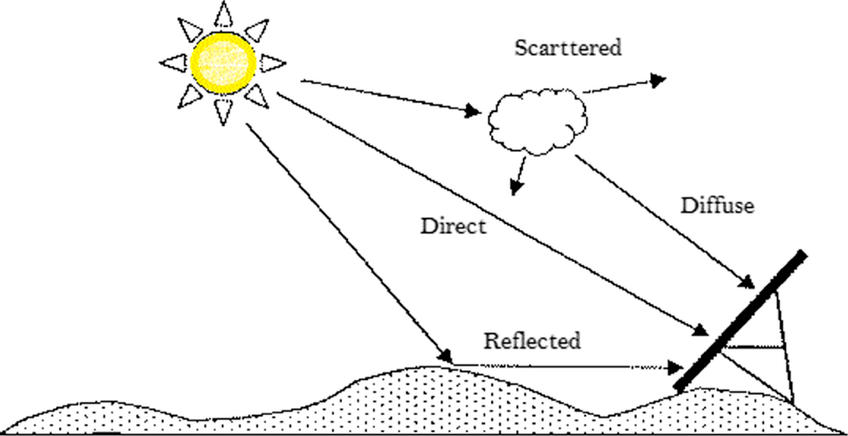
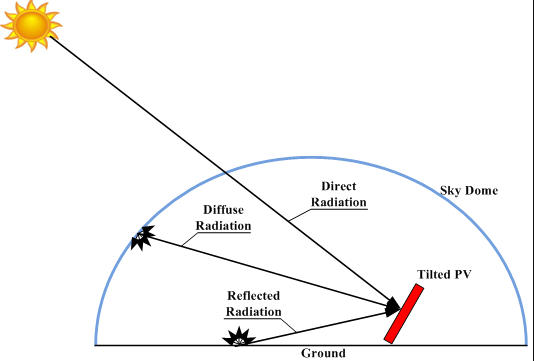
2. Direct radiation, diffuse radiation, and reflected radiation on a tilted PV module.
Related Article
Reference Link
https://www.sciencedirect.com/topics/engineering/reflected-radiation