
Soil Temperature | Web Scraping Tool | ScrapeStorm
Abstract:Soil Temperature refers to the thermal condition at different depths within the soil, typically expressed in degrees Celsius (℃) or Kelvin (K). ScrapeStormFree Download
ScrapeStorm is a powerful, no-programming, easy-to-use artificial intelligence web scraping tool.
Introduction
Soil Temperature refers to the thermal condition at different depths within the soil, typically expressed in degrees Celsius (℃) or Kelvin (K). It is a core parameter describing the thermodynamic state of soil, directly influencing biochemical processes such as seed germination, root growth, microbial activity, and soil organic matter decomposition. Soil temperature exhibits distinct diurnal and annual variation patterns with depth, controlled by multiple factors including surface radiation balance, soil thermal properties, vegetation cover, and soil water content. As an important variable in land surface processes, soil temperature holds a fundamental position in agriculture, meteorology, hydrology, and environmental science.
Applicable Scene
Soil temperature (at various depths) is widely applied in agricultural planting management, meteorological forecasting, frozen ground research, ground-source heat pump design, and climate change monitoring. In agriculture, soil temperature data at different depths are used to determine optimal sowing periods, assess root growth environments, and predict phenological stages, serving as an important basis for guiding agricultural production. In meteorological and climate research, soil temperature influences energy exchange between the surface and atmosphere, making it a key input parameter for land surface process models and numerical weather prediction. In permafrost engineering, monitoring ground temperature at different depths is crucial for assessing freeze-thaw risks and ensuring infrastructure safety. Additionally, in the renewable energy sector, shallow ground temperature data support the design of ground-source heat pump systems; in ecology, soil temperature profiles help understand the responses of carbon and nitrogen cycles to climate change.
Pros: Soil temperature intuitively reflects the variation patterns of soil thermal conditions with depth, providing fundamental data for understanding surface energy balance and soil heat transfer processes. Through layered observations, continuous temperature profiles from the surface to deeper layers can be obtained, revealing the processes of heat storage, conduction, and release in soil. Soil temperature is sensitive to climate change responses, serving as an effective indicator for monitoring global warming and permafrost degradation. Furthermore, soil temperature measurement technology is mature, with relatively low sensor costs, facilitating long-term automated and networked observations.
Cons: Accurate measurement of soil temperature is influenced by sensor burial depth, installation quality, and the contact condition between the probe and soil, requiring strict quality control for data comparability across different depths. Its spatiotemporal variability is considerable, significantly affected by spatial heterogeneity in surface cover, soil texture, and water content, making it difficult for single-point observations to represent regional conditions. Deep soil temperature changes slowly, requiring long-term continuous observations to capture effective signals, which places high demands on the stability of observation facilities and data acquisition systems. Additionally, the physical relationships between soil temperatures at different depths are complex, making it difficult to fully reveal heat conduction mechanisms through observational data alone, often requiring comprehensive analysis combined with soil thermal property parameters.
Legend
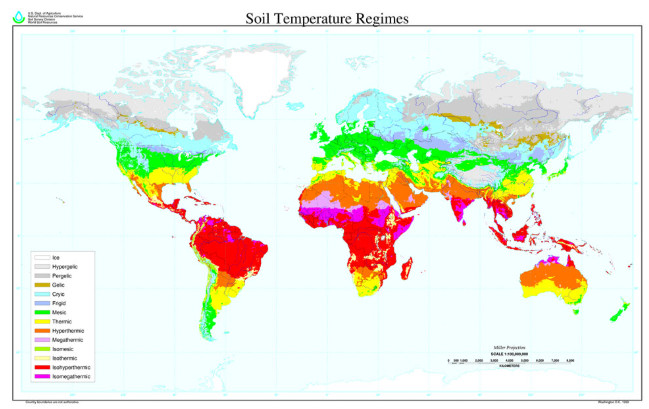
1. Soil temperature regimes.
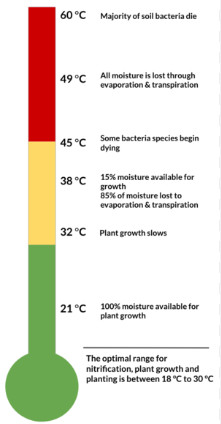
2. Soil temperature.
Related Article
Reference Link
https://www.sciencedirect.com/topics/earth-and-planetary-sciences/soil-temperature